DecisionOps — The Business Layer Above Data
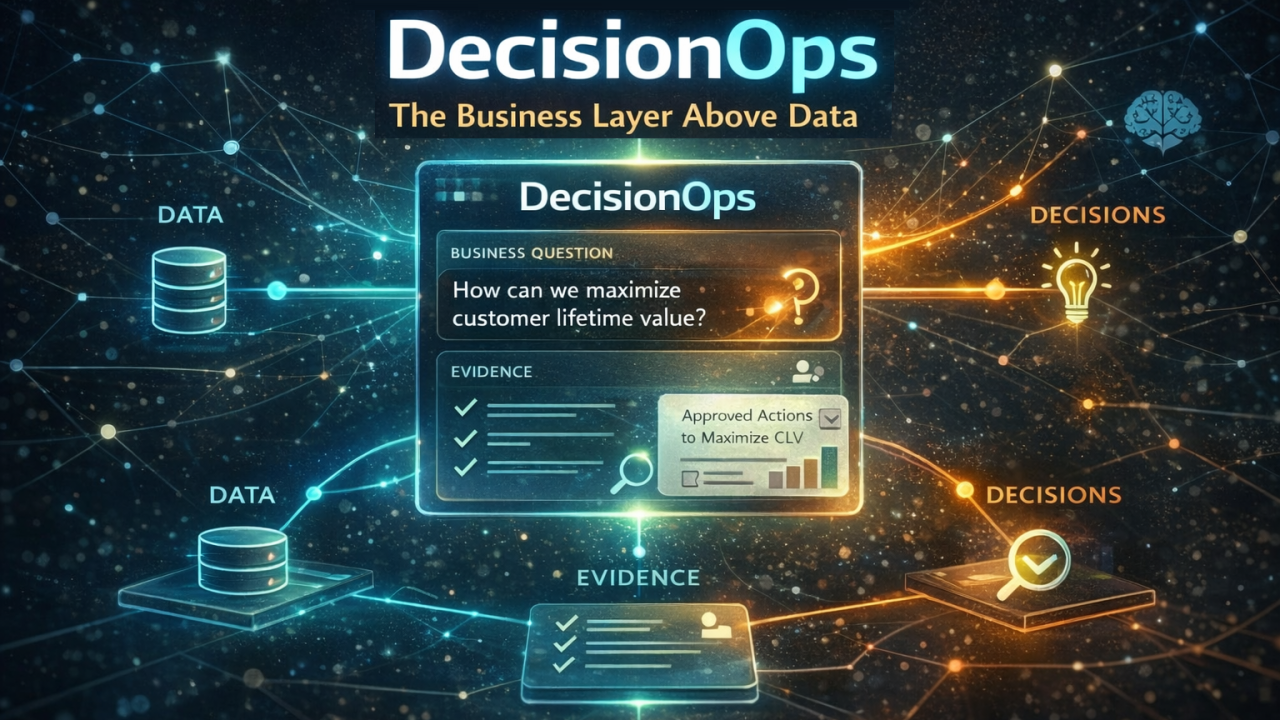
Because Learning Nodes focuses on DecisionOps, it would be a great moment to define it as a word and lay out its main strategic pillars.
DecisionOps is the operating discipline that turns business questions into defensible decisions by making Assumptions, Interpretations, and Evidence explicit, versioned, and reusable.
DecisionOps tackles:
-
Question Debt: The unanswered business questions that pile up silently — until they surface as costly reversals. Not because the data wasn't there, but because the question was never properly framed, tracked, or resolved.
-
Decision Decay: The slow rot that happens after a decision is made. The reasoning disappears, the assumptions go unrecorded, and all that survives is a dashboard or a slide. Six months later, no one remembers why it was decided — only what was decided. And when conditions change, there's nothing to revisit.
Core Idea: Above Tools, Below Decisions
DecisionOps exists above tools and below decisions.
Organizations already have:
- Data tools (SQL, BI, Excel)
- Governance tools (catalogs, lineage)
- Collaboration tools (Slack, Confluence)
What they do not have is infrastructure for how decisions are formed from data.
Learning Nodes fills that gap.
The Biggest Problem: Invisible Reasoning
The biggest failure in modern analytics is not bad data — it is invisible reasoning.
Today:
- assumptions are implicit
- interpretations compete silently
- validation is informal or skipped
- context is lost as soon as artifacts are shipped
Learning Nodes is designed to externalize, structure, and preserve reasoning over time.
How this shows up in everyday work
Making decisions first-class objects:
- Decisions are treated as first-class objects, not outcomes
- Business questions, assumptions, interpretations, and evidence are explicit and structured
- Tools (Excel, dashboards, notebooks) are framed as artifacts, never as the core workflow
Making assumptions explicit:
- Assumptions are named, versioned, and challengeable
- Multiple interpretations can coexist and be compared
- Validation is a phase, not a feeling
- Decisions have memory: past context can be revisited, forked, or reused
Fluid collaboration:
- DecisionOps is not role-specific software. It is a shared decision workspace where different roles appear at different moments — naturally.
- Stakeholders, analysts, SMEs, DEs, DS/ML, and AI agents all engage with the same question, but not in the same way or at the same time.
Common Traps (Don't go down this route)
- Tool comparisons ("better than Excel", "replacement for BI")
- Feature-led explanations
- Workflow diagrams that end at "delivery"
- Treating "confidence" as subjective
- Presenting validation as a checkbox
- Linear "handoff" metaphors
- Org-chart thinking
- Over-indexing on AI novelty
Who this is for
If you're an analyst, DecisionOps gives you leverage: it turns your work from reactive delivery into orchestration of understanding.
If you're a leader, DecisionOps gives you clarity: it lets you see why a decision was made, not just what was decided.
For risk, compliance, and legal teams, DecisionOps provides something they rarely get today: a clear, auditable trail of assumptions, evidence, and rationale behind critical decisions.
The bottom line
Most organizations don't fail because they lack data, tools, or talent. They fail because decisions are not treated as a system.
DecisionOps is an attempt to change that: to give business questions structure, to make reasoning explicit, and to turn decisions into durable assets rather than one-off outcomes.
Decision-making is becoming the last human advantage. It deserves its own operating model.